
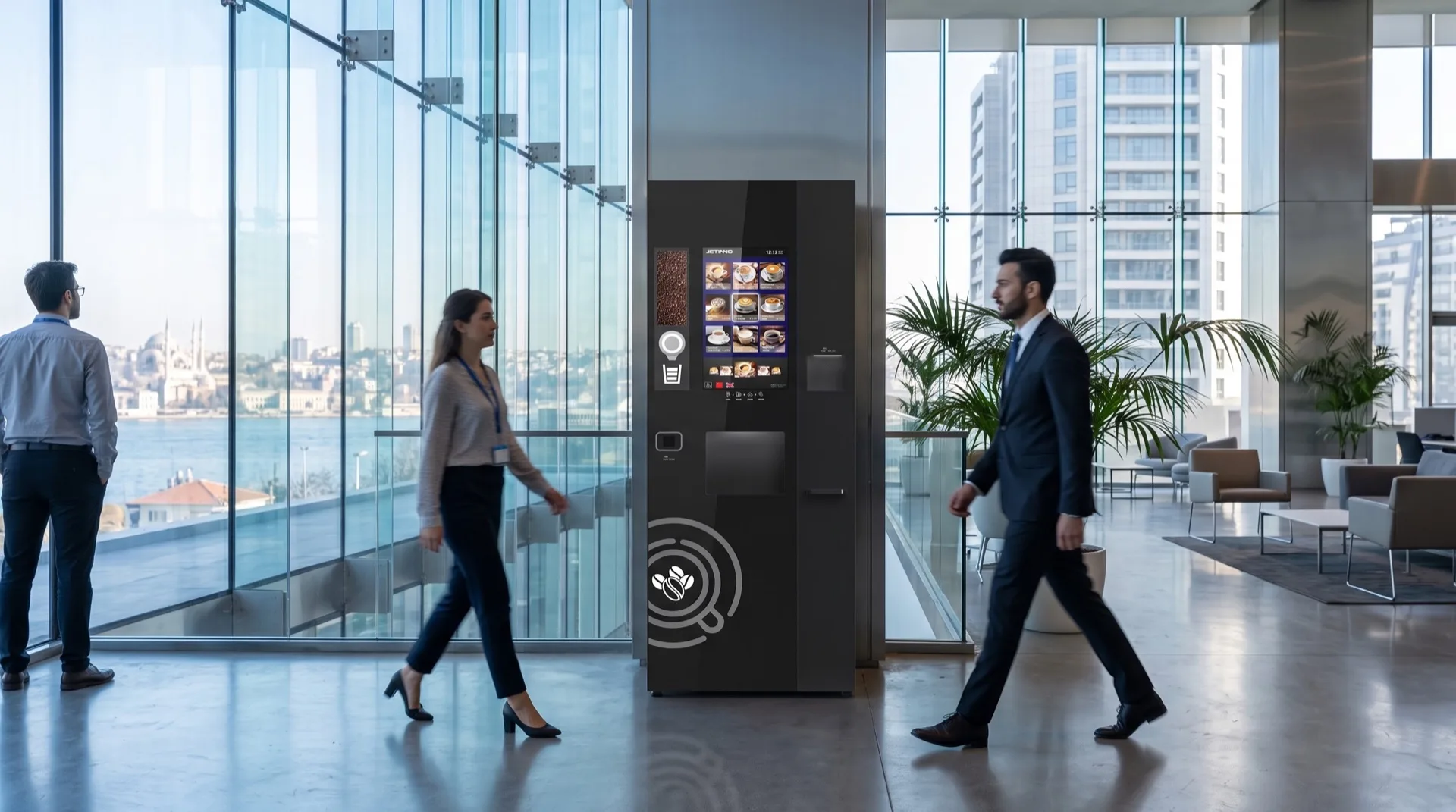
Finding a reliable coffee vending machine in Istanbul is less about the machine itself and more about the daily rhythm of the place where it stands. Offices in Maslak and Levent empty into the lobby twice a day, hospitals run shifts around the clock, and university campuses in Ataşehir and Kadıköy have lecture breaks that last fifteen minutes. A machine that grinds beans per cup and also pours tea covers all three moments without a barista.
CoffeeVar is the exclusive distributor of the Jetinno JL300 in Turkey. We are based in Antalya, we deliver and install across the country within about 72 hours after the contract is signed, and we have service engineers in the main cities. The JL300 is a floor-standing fully automatic unit: fresh beans ground per cup, plus tea and hot chocolate from the same touch screen. The menu holds 8 to 12 drinks, and payment runs on coins, tokens, banknotes, bank cards, contactless and QR code.
Where a Coffee Vending Machine Pays for Itself
Not every location needs the same setup. The pattern that repeats across the city is simple: a captive audience, a predictable break, and no nearby alternative within a two-minute walk.
- Office floors and plazas in Maslak, Levent and Ataşehir. Staff drink two to four cups a day and the nearest decent cafe is often a ten-minute walk plus a queue.
- Hospitals and clinics. Visitors, patients and night-shift staff need something hot at hours when the cafeteria is closed.
- Universities. Faculty buildings, libraries and dormitory entrances see sharp peaks between classes.
- Shopping malls and entertainment centres. High footfall, but the machine has to be fast and the menu has to include tea.
- Istanbul Airport and transport hubs. Long waiting times, travellers who want a quick cup without joining a queue at a counter.
- Factories and logistics sites on the European and Asian sides, where shift workers pass the same point several times a day.
If your location has at least 40 to 50 people passing a single point daily, the numbers usually work. Below that, a smaller configuration still makes sense, but the payback stretches.

Which JL300 Configuration Fits Your Location
The machine is built around a modular capacity system, so you are not buying more hardware than you need. Configurations range from about 40 cups per refill up to 250.
| Location type | Suggested capacity | Why |
|---|---|---|
| Small office, up to 40 staff | 40 to 60 cups per refill | Refill every few days, minimal footprint |
| Mid-size office or clinic | 80 to 120 cups per refill | Daily traffic without daily servicing |
| Hospital, campus, mall | 150 to 250 cups per refill | Peak hours and mixed tea and coffee demand |
All versions run on a standard 220V socket. If the location has no plumbing, the water tank version works without any installation work, which matters in older buildings and rented floors where you cannot touch the walls.
Telemetry is included. You see sales by drink, by hour and by day from a phone or laptop, which tells you when to refill and which recipe to adjust. The machine carries a 2-year warranty.
Two Ways to Get a Machine: Rental Partnership or Purchase
You can buy the JL300 outright for 7,200 USD. You own the asset, you keep all revenue, and you handle refills and first-line cleaning. This suits locations that already run a cafeteria or a facility team.
The second route is a rental partnership. You invest 0. CoffeeVar installs and operates the machine, handles refills, cleaning and service, and you receive 20% of sales, which comes to about 18,000 per month at typical traffic. The contract runs for 2 years and your sales are visible online at any time.
To see whether the numbers fit your floor, use your own assumptions. Cup cost is 12–20, sale price is 80–120, and a typical location sells 30–60 cups a day. That gives monthly turnover of about 90,000 and payback of 6–12.

Rental vs Purchase at a Glance
| Rental partnership | Purchase | |
|---|---|---|
| Upfront investment | 0 | 7,200 USD |
| Who operates the machine | CoffeeVar | You |
| Your income | 20% of sales, about 18,000 per month | All revenue after your costs |
| Contract | 2 years | No contract term |
| Reporting | Online, visible to you | Online, visible to you |
| Best for | Locations without staff to manage refills | Companies that want the asset and the full margin |
Delivery, Installation and Service
Once the contract is signed, delivery and installation happen within about 72 hours. Our engineers handle the setup, connect the machine, run the first test cups and show your team how refills and daily cleaning work. Service engineers are based in the main cities, so a fault does not mean waiting for someone to travel from another region.
For a site on the European side, a plaza in Levent or a clinic near a central district, the process is the same as for a factory on the Asian side. The only thing we check in advance is the route to the floor, the door width and whether you have a 220V socket within reach. If not, we plan around it.