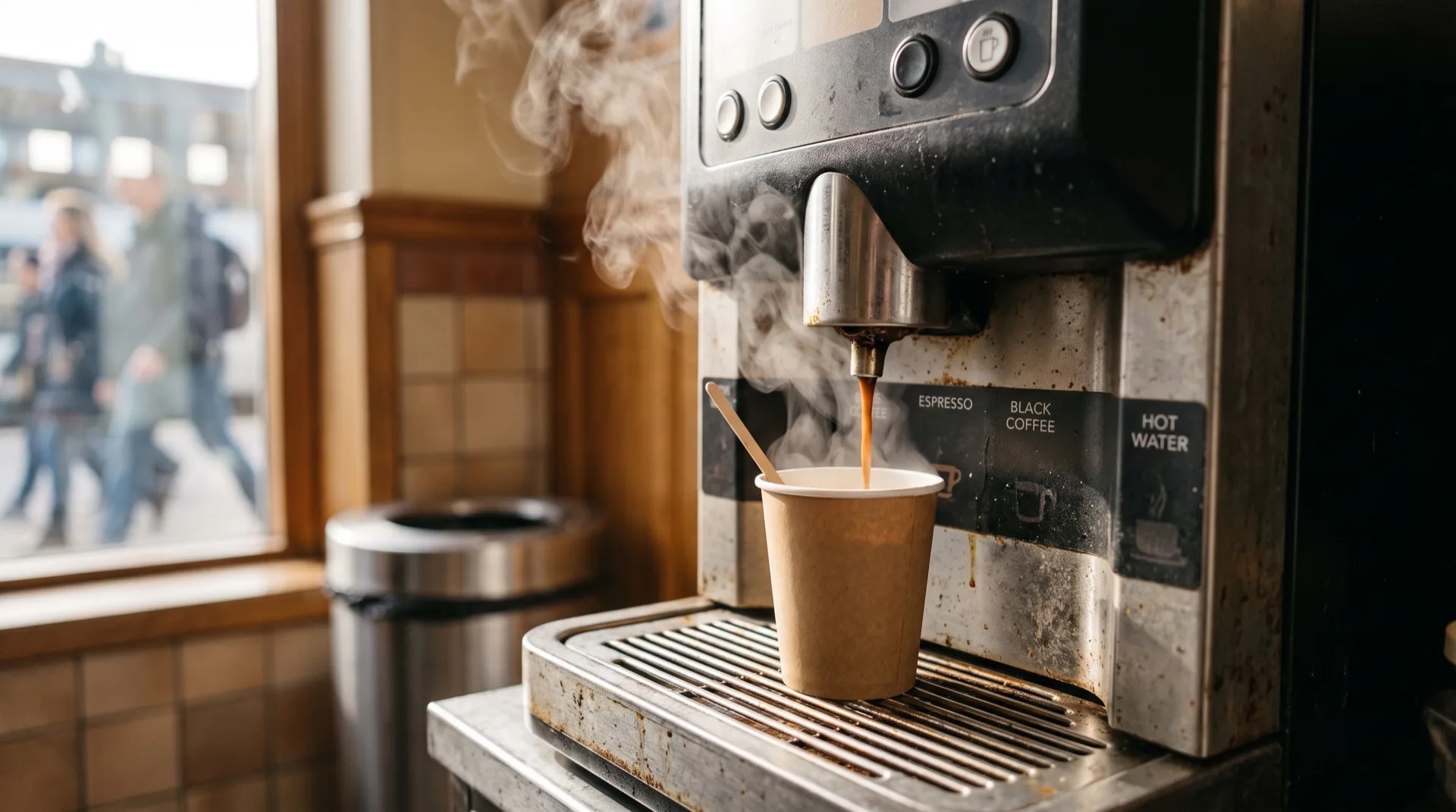
If you have ever stood in front of a coffee vending machine and wondered how a fresh cup appears in under a minute, the answer is a short chain of mechanical steps. A coffee vending machine stores ingredients, grinds beans on demand, heats water, brews under pressure, mixes milk or chocolate where needed, releases a cup and handles payment. Each stage is controlled by a board that also reports status remotely. This article walks through the whole process, from the hopper to the cup, and explains what usually wears out and how monitoring catches problems early.
Inside the Cabinet: The Main Modules
A floor-standing automatic machine is built around a few clearly separated modules. Knowing them makes the rest of the process easy to follow.
- Bean hopper: holds whole roasted beans and feeds them down to the grinder by gravity. Some machines have a second hopper for decaf or a different blend.
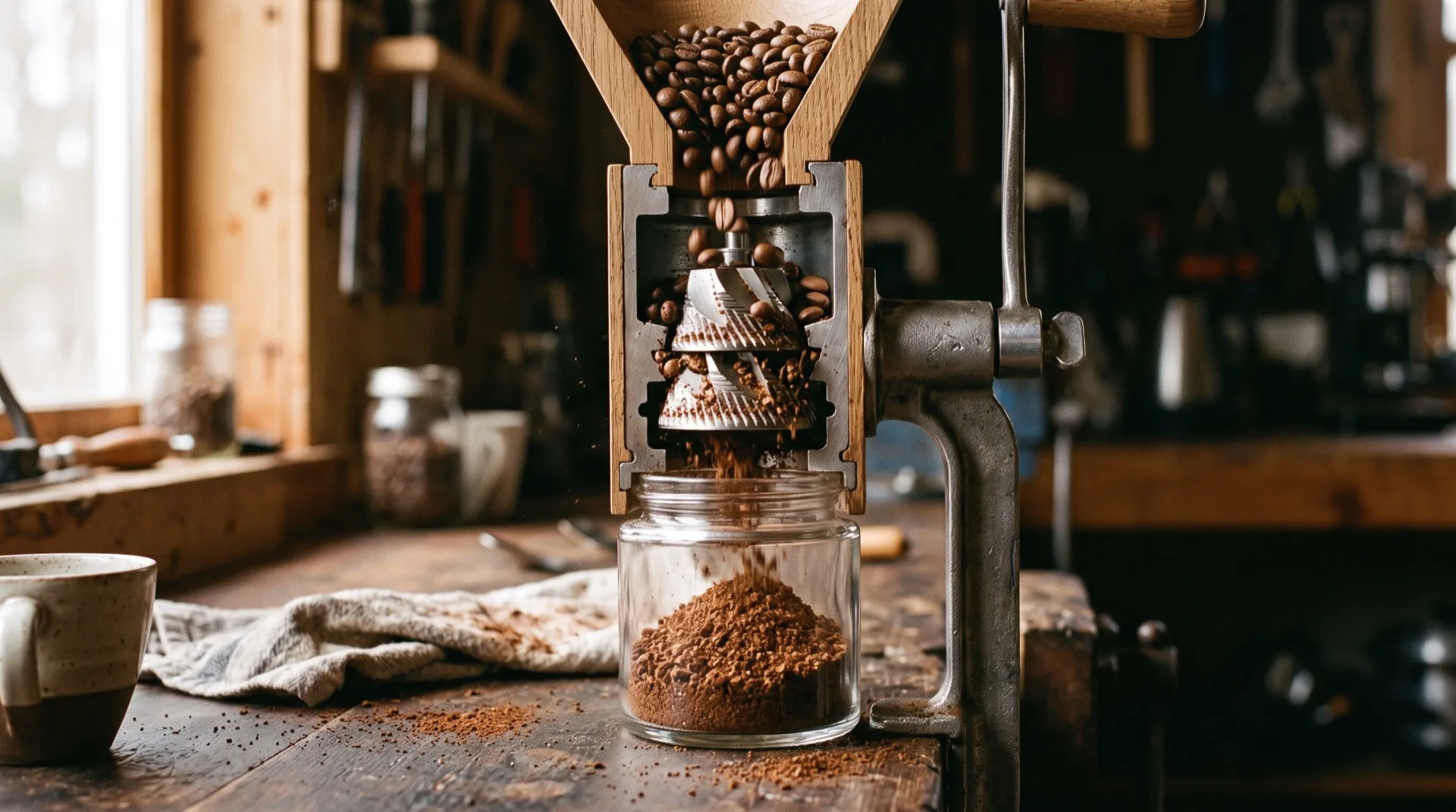
- Grinder: burrs crush the beans to a setting chosen by the technician. Grind size decides how fast water passes through the coffee and how strong the cup tastes.
- Brewing unit: a chamber that receives the ground coffee, tamps it and pushes hot water through it at pressure. After brewing, it ejects the used puck into a waste container.
- Boiler: heats water to brewing temperature and keeps a reserve ready. Temperature stability matters more than raw power, because a few degrees of drift change the flavour.
- Powder mixers: separate canisters for milk powder and drinking chocolate, each with its own auger and whipping motor. They dose powder into hot water to make milk drinks and hot chocolate.
- Tea line: a dedicated outlet that dispenses hot water over tea, either from a leaf canister or a concentrate, depending on the configuration.
- Water supply: a machine can run from the mains through a filter or from an internal water tank. The tank version needs no plumbing and is common in locations where a water line is not available.
- Cup dispenser: a column that drops one cup into the delivery position for each order.
- Payment module: coin validator, token reader, banknote acceptor and card or contactless terminal, depending on how the machine is equipped.
- Telemetry unit: a small communication module that sends sales, stock levels and error codes to a monitoring platform.
What Happens After a User Selects a Drink
The moment a drink is chosen and paid for, the controller runs a fixed sequence. It checks that the selected ingredient canisters have stock and that the boiler is at temperature. The grinder starts and doses the right weight of coffee into the brewing unit. The unit closes, tamps and receives hot water at pressure for a set number of seconds. Meanwhile the cup dispenser releases a cup into place.
If the recipe includes milk or chocolate, the corresponding auger turns for a measured time and the mixer blends the powder with hot water in a separate chamber, then pours it into the cup. For tea, the machine simply sends hot water through the tea line. Finally the brewing unit opens and ejects the puck, the delivery door closes and the machine resets for the next order. The whole cycle usually takes well under a minute, and the drink menu can range from a handful of options to a much longer recipe list depending on how the machine is programmed.
Machines that accept coins and tokens as well as cards are especially useful in locations with mixed audiences. You can see how these configurations look on the coin operated tea and coffee vending machine page.
Water, Temperature and Grind: Where Taste Is Decided
Three variables decide whether the cup tastes the same on Monday morning and Friday afternoon. The first is water quality, which is why a filter is part of a proper installation. The second is boiler temperature, held within a narrow band by the controller. The third is grind size, which shifts slightly as burrs wear and needs periodic adjustment.
A machine that runs from a water tank adds one more routine: refilling and cleaning the tank. A mains-connected machine removes that task but depends on stable water pressure. Both approaches work well, and the choice is usually made on the site rather than in the catalogue.
Payment and Telemetry: The Machine as a Business
The payment module is what turns a machine into a small retail point. Coin and token operation suits closed environments such as factories and staff canteens. Banknote and card readers, including contactless and QR payments, suit public locations where customers carry little cash.
Telemetry is the quieter but more valuable part. The machine reports how many cups were sold, which recipes are popular, when a canister is nearly empty and when a component returns an error. The operator sees this remotely and plans refills and repairs instead of guessing. For the location hosting the machine, this also means sales figures are not a matter of trust, they are recorded.
| Business model | Who buys the machine | Who handles refills and service | What the location receives |
|---|---|---|---|
| Purchase | The location or operator | The owner, with service support | All revenue from sales |
| Rental as a location partnership | No purchase by the location | The supplier installs and operates | A share of sales, reported through monitoring |
The purchase route gives full control of the menu and the margin. The partnership route removes the upfront cost and the operational work, in exchange for a share of turnover. Which one fits depends on traffic, available space and how much attention the site wants to give the machine. A useful starting point is the coffee vending machine calculator, which turns daily cup counts into a realistic monthly picture.
Maintenance Cycles and What Breaks Most Often
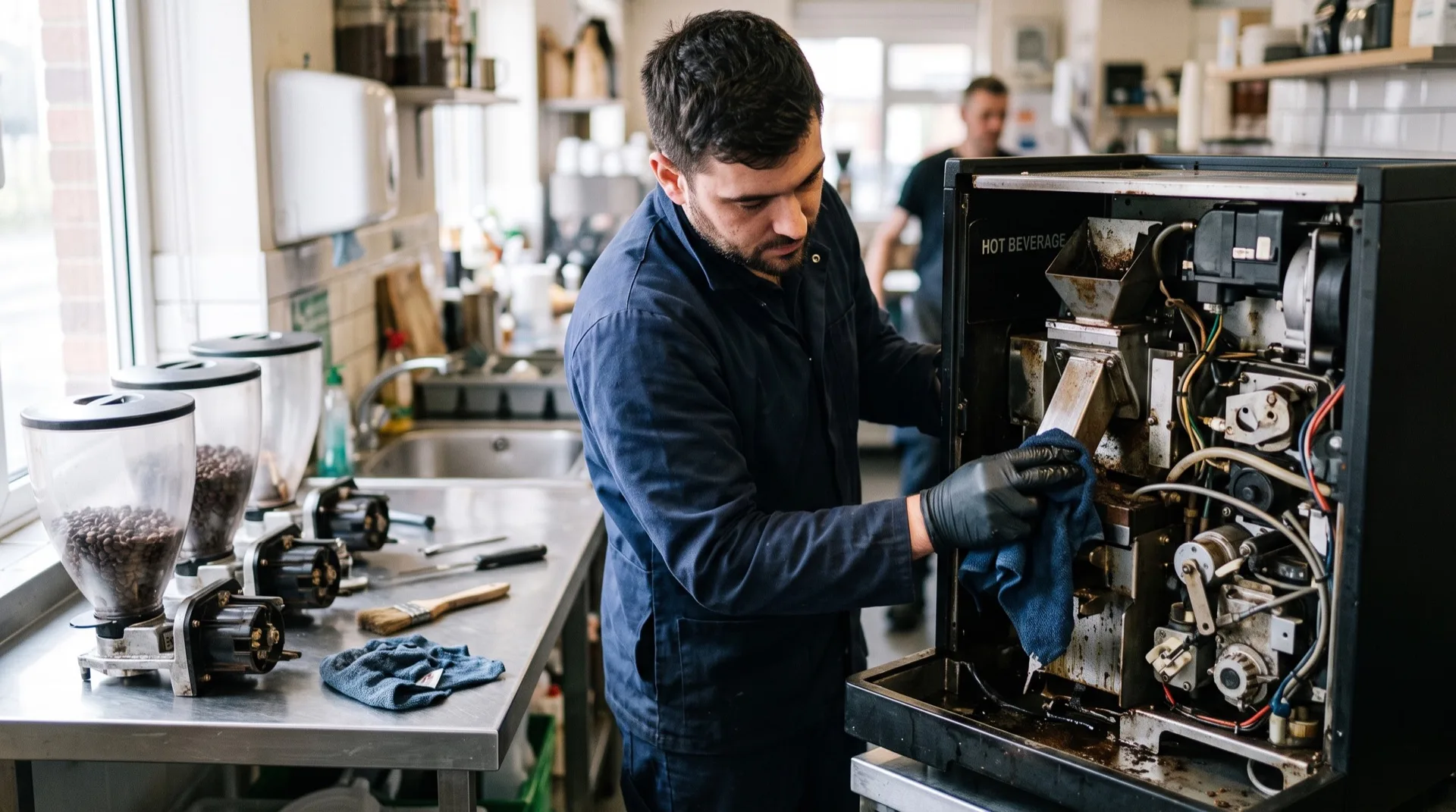
Preventive maintenance follows a simple rhythm. Daily or every few days, the waste container is emptied and the delivery area is wiped. Weekly, the brewer is rinsed and the powder canisters are checked for clumping. Monthly, the brewer is cleaned more thoroughly, the grinder is checked for wear and the water filter is inspected. Annually, worn seals and tubing are replaced.
The parts that fail most often are predictable. Grinder burrs dull and change the taste before they stop working. Brewer seals harden and start to leak. Powder augers and mixers clog when humidity gets into the canisters. Coin validators reject good coins when they are dirty. Dispensing hoses crack over time.
None of these failures is dramatic on its own, but each one costs sales if it is discovered late. This is where telemetry earns its place. A drop in sales for one recipe, a repeated error code or a canister that empties faster than usual all point to a specific part. The technician arrives with the right spare instead of diagnosing on site, and the machine spends less time out of service.
Choosing a Machine That Fits the Location
The technical process is similar across automatic machines. What differs is configuration: which drinks are offered, whether tea and hot chocolate are included, whether the machine is plumbed in or uses a tank, how many cups it holds between refills, and which payment methods are enabled. A site with 40 daily customers and a site with several hundred need different setups, and the menu should follow what people actually order.
For a closer look at models and configurations, the coffee machine catalogue shows what is available, and the tea and coffee vending machine page covers machines that brew both. If you want to compare buying against a partnership arrangement, see the sale and rental options.
In short, a coffee vending machine works by grinding on demand, brewing under controlled temperature and pressure, mixing milk or chocolate where the recipe calls for it, and reporting its own status to an operator. Understanding that chain makes it much easier to judge whether a machine will serve a location well, and to keep it running once it is installed.